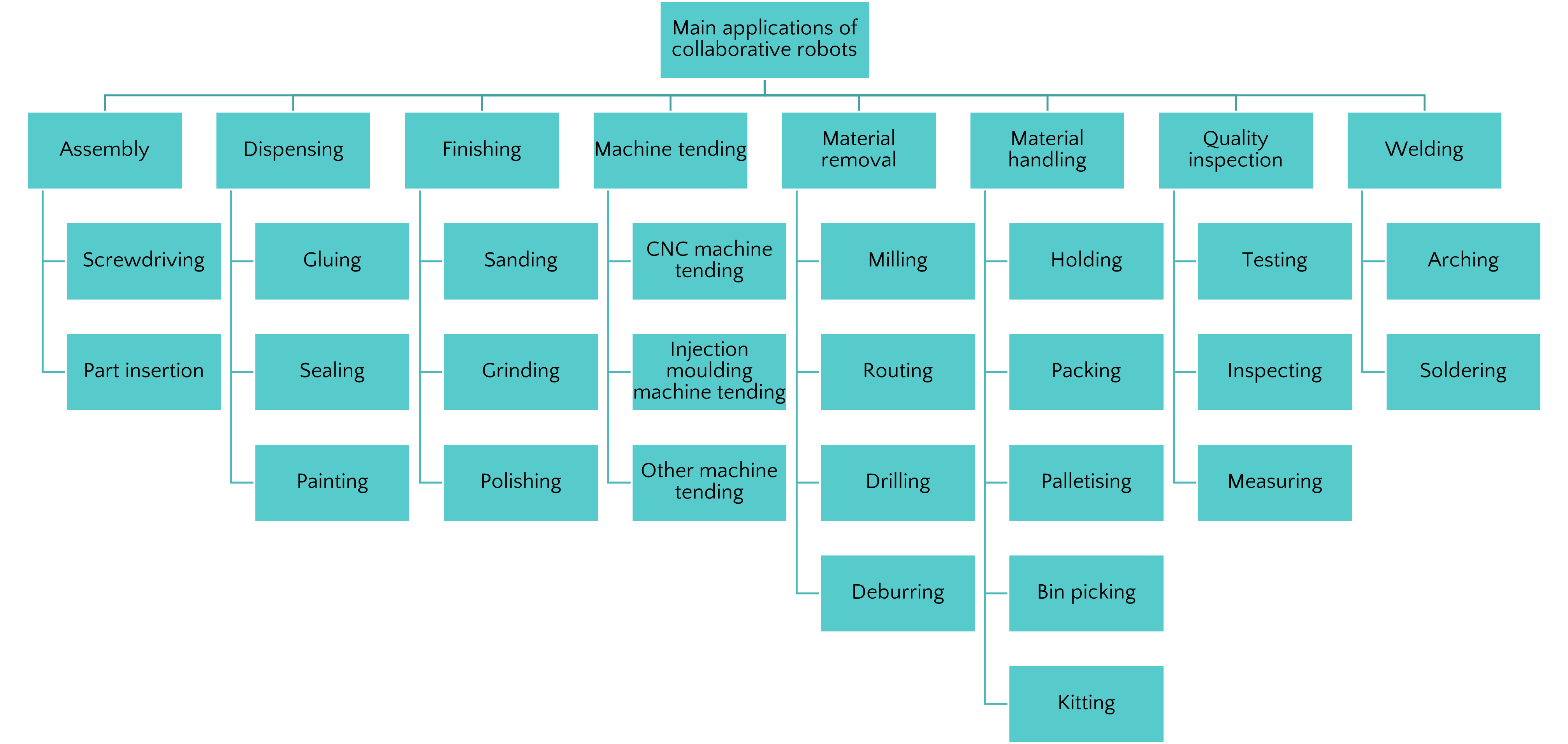
The main advantage of CR compared to traditional robotics is certainly the possibility to use robots in close collaboration with workers. This is made possible by the four main soft interaction modes that, according to ISO/TS 15066, characterise a collaborative robot and distinguish it from a traditional robot: safety-rated monitored stop, hand-guiding, power and force limiting, speed and separation monitoring. These features allow the cobot to safely coexist with operators, creating collaborative applications where the capabilities of one complement those of the other.
In the SUPSI Mini-Factory, a work cell has been developed to advance new collaborative robotics applications. This cell is equipped with an ABB Gofa, a Universal Robot UR5, and an Igus Rebel, along with various end-effectors, vision systems, and two workbenches: one fixed and one mobile.
The Team working on this solution aims to develop collaborative robotics application implementing what they define as Natural and Intelligent Human Robot Collaboration:
Natural and Intelligent Human Robot Collaboration is a sophisticated form of collaboration where humans and cobots contribute equitably to the task, share a workspace, possess high-levels of situational and operational awareness enabling simultaneous and adaptive actions and decisions.
If you're interested in collaborative robotics, don't hesitate to contact us via email at elias.montini@supsi.ch.
Collaborative Robotics Applications (Videos)
Laboratory setting:
-
Tower of Hanoi (to be updated)
Industrial setting:
Available Thesis and projects
If you’re interested in thesis, don’t hesitate to contact us via email at elias.montini@supsi.ch.
-
Investigating human-factors in collaborative robotics
-
Maximizing productivity and worker welfare in woodworking: a study on the implementation of collaborative robots
-
Maximizing productivity and worker welfare in metalworking: a study on the implementation of collaborative robots
Publications
2024
Montini, E., Ploner, G., Matteri, D., Cutrona, V., Rocco, P., Bettoni, A., & Pedrazzoli, P. (2024). Impact of Collaborative Robots on Human Trust, Anxiety, and Workload: Experiment Findings. In IFIP International Conference on Advances in Production Management Systems (pp. 401-415). Cham: Springer Nature Switzerland. Link Best Academic Paper
Montini, E., Daniele, F., Agbomemewa, L., Confalonieri, M., Cutrona, V., Bettoni, A., Rocco, P. & Ferrario, A. (2024). Collaborative Robotics: A Survey From Literature and Practitioners Perspectives. Journal of Intelligent & Robotic Systems, 110(3), 117. Link
Montini, E., Cutrona, V., Dell’Oca, S., Landolfi, G., Bettoni, A., Rocco, P., & Carpanzano, E. (2024). An industrial human-robot collaboration case study for workers' well-being. Procedia CIRP. Link
2023
Montini, E., Cutrona, V., Dell’Oca, S., Landolfi, G., Bettoni, A., Rocco, P., & Carpanzano, E. (2023). A framework for human-aware collaborative robotics systems development. Procedia CIRP, 120, 1083-1088. Link
Cutrona, V., Bonomi, N., Montini, E., Ruppert, T., Delinavelli, G., & Pedrazzoli, P. (2023). Extending factory digital Twins through human characterisation in Asset Administration Shell. International Journal of Computer Integrated Manufacturing, 1-18. Link
Montini, E., Agbomemewa, L., Daniele, F., Cutrona, V., Confalonieri, M., Ferrario, A., Rocco, P. & Bettoni, A. (2023, September). A Smart Work Cell to Reduce Adoption Barriers of Collaborative Robotics. In IFIP International Conference on Advances in Production Management Systems (pp. 702-715). Cham: Springer Nature Switzerland. Link
2022
Daniele, F., Agbomemewa, L., Confalonieri, M., Cutrona, V., Bettoni, A., Matteri, D., & Montini, E. (2022). Collaborative robotics adoption: KITT4SME report 2022 in collaboration with TRINITY Robotics. Link
Montini, E., Cutrona, V., Bonomi, N., Landolfi, G., Bettoni, A., Rocco, P., & Carpanzano, E. (2022). An iiot platform for human-aware factory digital twins. Procedia CIRP, 107, 661-667. Link
2020
Bettoni, A., Montini, E., Righi, M., Villani, V., Tsvetanov, R., Borgia, S., Secchi, C. & Carpanzano, E. (2020). Mutualistic and adaptive human-machine collaboration based on machine learning in an injection moulding manufacturing line. Procedia CIRP, 93, 395-400. Link
Partners




Projects