Abstract
The manufacturing industry constantly faces complex challenges: unpredictable events, fierce
competition, shorter product life-cycles, increased variability and fluctuating demand are just a
short-list. In this continuously evolving scenario, industries are attempting to exploit the latest
advances in information and communication technology, to enhance productivity, efficiency and
long-term planning.
This demand for a digital transformation impacts each phase of a company's life cycle, from product
and process design to the optimization and day-to-day management. While the human role is still
essential and significant, human activities will unavoidably change their nature in terms of increased
complexity and heterogeneity of the work.
In order to deal with the educational needs to handle this complexity and heterogeneity, in the last
decade numerous learning factories have been developed. Learning factories, as a teaching and
learning ecosystem, have shown to be effective for developing theoretical and practical knowledge
in a real production environment and are hence a suitable testing bed for both validating new
technologies and delivering peculiar training through innovative hands-on methodologies.
This paper portrays the specificities of the learning factory implemented at the University of Applied
Sciences and Arts of Southern Switzerland: the SUPSI Mini-Factory. The SUPSI Mini-Factory is a
learning factory in the narrow sense, as it provides a real value chain for a physical product where
participants can perform, evaluate, and reflect their own actions though a hands-on learning
approach. The SUPSI Mini-Factory produces and assembles personalized tangram game-sets,
packaged into diverse boxes. Tangram is a Chinese dissection puzzle, consisting of seven geometrical
flat shapes which are put together to form diverse silhouettes.
Firstly, the guiding principles, chosen for the SUPSI Mini-Factory development, are introduced and
justified considering both didactical and research purposes. Secondly, the SUPSI Mini-Factory
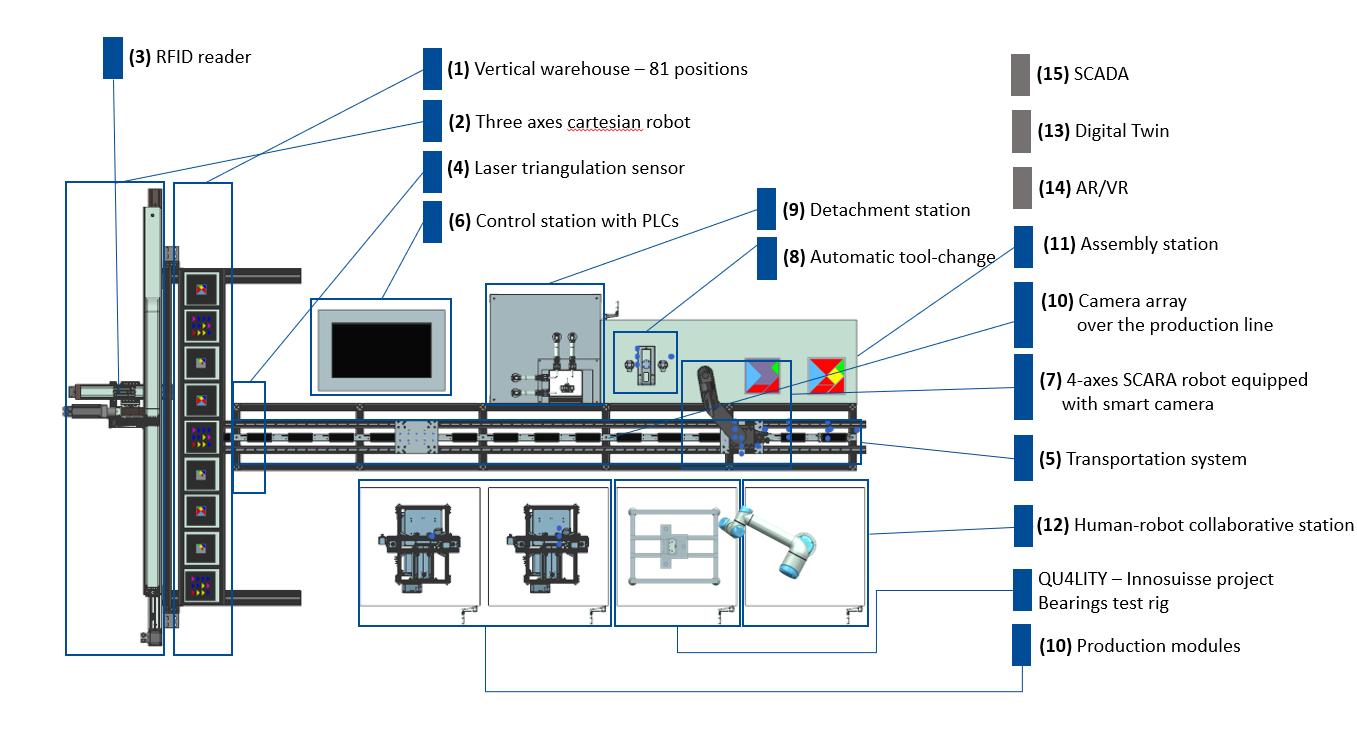
configuration is clearly outlined, with a specific regard to product, production process and
components. The SUPSI Mini-Factory is thenceforth described exploiting the morphology
classification proposed by Abele [1] framing it in a solid academic framework, thus enabling an
indicator driven assessment and a possible comparison with other similar realities around the world.
Two different use cases within the SUPSI Mini-Factory are then presented. The first one, mainly
focused on research aspects, shows how, during the activities of the Innosuisse (Swiss Innovation
Agency) founded project called Qu4lity, the SUPSI Mini-Factory has turned out to be an adding value
instrument for supporting the conception, the development and the validation of innovative
technologies for quality control. The second use case, mainly focused on didactical activities, shows
how the SUPSI Mini-Factory has had a central role for the development of different learning paths
in the field of automation and augmented/virtual reality within two EIT manufacturing (European
Institute of Innovation & Technology) research projects: MIRRORLABS and M-NEST-I.
Finally, future projects and scenarios of SUPSI Mini-Factory are outlined.